.png?width=200&height=100&name=Celectric_Logo%201459x593%20(PNG).png)
If you work in industrial processing, you might find it strange that a vortex flow meter intended for high-temperature steam or natural gas is often calibrated using ordinary water. It seems counterintuitive—shouldn't you calibrate with the actual fluid you intend to measure?
In the world of flow measurement, the answer lies in the physics of "The Von Kármán Effect" and the sheer practicality of fluid dynamics.
1. The Principle of Independence
The most important reason is that a vortex flow meter is a kinematic device.
Vortex meters work by placing a "shedder bar" in the flow path. As fluid passes this bar, it creates alternating swirls known as vortices. The frequency (f) at which these vortices are shed is directly proportional to the velocity (v) of the fluid and the width of the shedder bar (d).
The critical constant here is the Strouhal Number (St), defined by the formula:
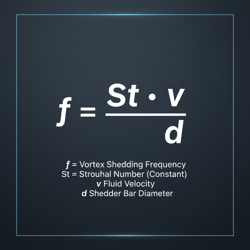
Because St remains constant over a wide range of Reynolds numbers, the calibration factor (the K-factor) remains the same whether the fluid is a liquid or a gas. Once the meter "learns" how to count pulses in water, that knowledge translates perfectly to other fluids.
2. Stability and High Density
Water is an incompressible fluid with a high density. This makes it an incredibly stable medium for testing:
- Minimal Pressure Fluctuations: Unlike air or gas, water doesn’t compress, meaning the flow rate stays steady during the test.
- Stronger Signals: Because water is dense, the pressure pulses generated by the vortices are much stronger and easier for the meter’s sensors to detect during the initial characterization.
3. Safety and Environmental Impact
Calibrating with steam or hazardous gases is dangerous and expensive.
- Steam requires massive amounts of energy to produce and carries a risk of burns.
- Natural Gas is flammable and requires complex recovery systems.
- Water is safe, non-toxic, and can be easily recirculated in a closed-loop "flow rig" system.
4. Cost-Effectiveness and Accuracy
Building a high-precision gas calibration rig is significantly more expensive than a water rig. Water calibration systems use Gravimetric methods (weighing the water) or Master Meters, which can achieve uncertainties as low as $\pm 0.1\%$. This provides a highly accurate baseline that ensures the meter meets its specifications before it ever reaches your facility.
Summary
Calibrating a vortex flow meter with water isn't a "shortcut"—it's a scientifically backed method. Because the physics of vortex shedding is based on fluid velocity rather than fluid type, water provides the safest, most stable, and most accurate environment to define the meter’s accuracy.